From Here To Utopia
Pat the Bunny on radicalism, the burden of freedom, and the impermanence of identity
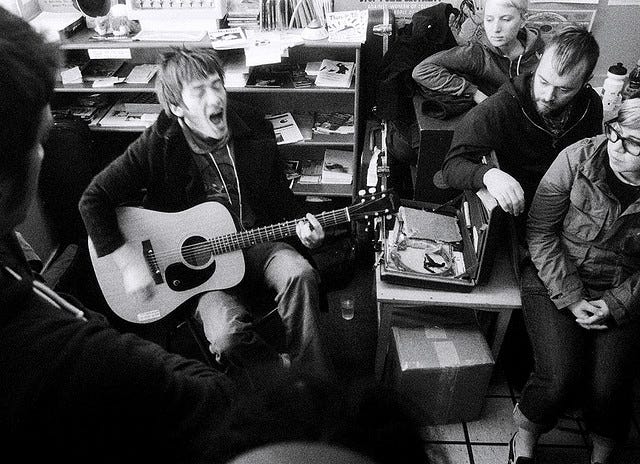
CW: addiction, depression, suicide
When I picture myself as a young man, I feel fairly confident that he would be disappointed with how his life had turned out.
It’s not a question of wealth or material circumstances – or at least, not in the way that you might think. My younger self would almost certainly feel that I live too comfortably. I’ve written before about my semi-feral youth, my incandescent rage against the system, my years spent hitchhiking and making cross-country Greyhound treks, sleeping in parks and busking for beer money and working only long enough to make enough money to get the hell out of this town, living “free” for better or for worse. Younger me would be disappointed with older me for staying in the same place for so many years; for maintaining a bank balance with more than three digits; for all of the compromises I’ve made to live a stable life; for not being more radical, more wild, more free. Younger me was so principled, and so serious about those principles, that like a too-rigid tree in a windstorm, he struggled not to snap.
I hope I don’t sound scornful towards my younger self. I feel a great deal of affection for him; I admire and honour his passion, his big heart, his adventurous temperament. I love and respect the person who I used to be, but I’m also deeply grateful that I don’t have to be that person anymore.
To be clear, I’m not disappointed with how my life turned out. My younger self and I don’t see eye to eye on many things. In some ways, we’re not really the same guy. Most of all, I would dispute his contention that I’ve become less radical as I’ve aged. If anything, I’ve grown more confident than ever in my youthful belief that the system is rotten to its core and needs to be attacked at its roots. I’ve just come to the conclusion that setting my life on fire wouldn’t work towards anybody’s liberation, least of all my own.
The trope of aging into conservatism is so ubiquitous that it’s a self-fulfilling prophecy for many. There aren’t many models in history or fiction for growing older as a radical. That’s why I’ve felt so drawn over the years to work of folk punk musician Patrick Schneeweis. His prodigious catalogue deals again and again with issues of growth, change, and negotiating your relationship with the person you used to be. In perhaps my favourite song of his, “Bitter Old Man”, released with his group Ramshackle Glory, Pat describes how the angry pessimism and despair of his youth have given way to a more mature “naive optimism” that a better world really is possible and attainable. He puts his finger on the simultaneously enduring and ever-changing nature of identity, describing his younger self with characteristic economy, wit and compassion:
I had a teenager’s conviction that
I would be different
Oh yeah, I was gonna be real different
From the person I became
Pat was a foundational figure of folk punk music,1 a legend of the subculture and a formative influence on generations of crusty travelling kids. His conversational and often humorous style of lyricism pairs surprisingly well with heavy topics, and his work veers effortlessly between being both political and personal, confessional and polemic, airily theoretical and brutally concrete. One of the most quotable songwriters of his generation, Pat prioritizes message over rhythm or rhyme, often producing lyrics that are ungainly on first listen but which live durably in your memory for years to come. His music provided the soundtrack to a critical phase of my life, a time when I was trying to unlearn self-destructive habits and leave limiting beliefs behind while staying true to my most cherished convictions, and it still has the power make me laugh or unexpectedly bring tears to my eyes after over a decade of listening.
A big part of what makes his body of work special is that it offers a rare window into the growth and development of a radical mind. Between the ages of 16 and 29, he documented his inner life and his beliefs with relentless and unflinching articulateness as he matured from a self-destructive and depressed teenage anarchist into a young adult newly sober and still mad as hell, and then into a man trying to build a meaningful adulthood that he hadn’t expected to survive long enough to see. As his songwriting voice developed and he outgrew many of his youthful positions, Pat frequently engaged in conversation with his earlier compositions, questioning or rebutting or adding nuance to his earlier takes, tugging on loose ends left hanging years before, and perennially revisiting the central question of his art and his life: What does it mean to be free?
I Burned My Bookshelf To Be Free – The Johnny Hobo Years
Freedom is often thought of as the preoccupation of the adolescent. It’s easy for young people to fall into the illusion that freedom can only be talked about in the future tense, and that once it’s attained, life will take on new meaning and purpose. Then again, teenagers often try to assert their agency in dramatic fashion, either through defiance or self-destruction. With age hopefully comes the wisdom to recognize that actions have consequences, but this insight can be taken to limiting extremes. The dowdy middle-aged demand to “be reasonable!” is toxic to the passion of youth, foreclosing as it does a universe of possibilities in the name of a safe and predictable existence of workweeks, credit card payments, condo fees and life insurance policies. The question of how to be free within the constraints of a controlling and demanding world is not regularly engaged with by most adults, whose focus understandably shifts from freedom to security, or even survival. To some extent, everybody who survives their teens and twenties capitulates and learns to behave reasonably, although many of us still harbour an unquenchable desire to rebel.
Pat picked up on this dynamic early on; on “No Trespassing Waltz”, he describes the negotiation between an insatiable desire for liberty and the relentless demands of the system:
And it’s true that we’re teenage fools
Trading five days a week to work and school
Just to sneak around on weekends watching for the cops
To waltz in abandoned parking lots
And call these cracks in the system a revolution
Like a lot of young misfits, Pat turned to a subculture – a crack in the system – for solace, and in his case, that wound up being punk. Although he at times questioned his place within punk (he describes himself on one song as “the billionth teenage boy with social problems to play the guitar”), his contributions to the genre wound up being transformative.
For the uninitiated, Pat’s musical output was dizzyingly prolific; he once remarked that he wrote songs “mostly because it didn’t occur to me not to”. Between 2004 and 2016, he fronted three separate bands – Johnny Hobo and the Freight Trains, Wingnut Dishwasher Union, and Ramshackle Glory – as well as putting out solo music under the name Pat the Bunny. After an almost decade-long hiatus, Pat returned to music earlier this year with a new project called Friends in Real Life. Although in each case he was the principal or only songwriter and often the only actual performer, each major project had a notably different musical style, and the name changes coincided with significant shifts in Pat’s living circumstances and political perspective.
The music of Johnny Hobo and the Freight Trains, created when Pat was a high school student in rural Vermont, is about as DIY as it gets. The recordings are low-fidelity and unevenly mixed. Most songs consist simply of Pat frantically strumming his acoustic guitar and singing as though he would literally explode if he tried to hold the words in; occasionally he’s accompanied by friends like trumpeter Flash-C, who seemed to only know how to play four or five notes, Ian Skumfuck, who played almost inaudible washtub bass, or Jeff-Face on enthusiastic and unstudied harmonica. Johnny Hobo’s debut release, 2003’s Anarchy Means I Hate You, was recorded with a $300 budget, most of which was spent on alcohol and weed for Pat’s buddies, who chimed in with backup vocals on key lines, occasionally fumbling over the lyrics or the timing but making up for it with sheer volume.
On paper, that sounds awful to listen to, but Pat’s passionate charisma and preternatural knack for narrative songwriting made the music of Johnny Hobo a smash hit in certain subcultural circles, helping to define the sound, aesthetic and thematic preoccupations of the nascent genre of folk punk. The band’s recordings were distributed by DIY Bandits, a no-budget label operated by Pat’s friend Pepe Bandit which was based out of squatted office space in New Haven, Connecticut. Johnny Hobo became the label’s most enduring star act. Pat was frequently out on tour, travelling as far from home as Rhinelander, Wisconsin. He regularly hitchhiked between shows, which were typically hosted in basements, under bridges, or in abandoned buildings. His reputation preceded him; even in towns he’d never visited before, Pat often played for crowds that sang along loudly with every lyric.
Those lyrics were a profoundly personal outpouring of adolescent despair, an ode to hopelessness and loneliness, and a scathing but impotent tear-down of an irrational unfeeling world. The chorus of “Harmony Parking Lot”, for instance, is a joyful anthem to nihilism:
Here’s to the rubble! A brick through every window!
A casket buried six feet deep for everybody’s heroes!
Here’s to our lives being meaningless
And how beautiful that it
Because freedom doesn’t have a purpose!
Exaltations of nihilism have a tendency to crash into the constraints of material reality, however; on “Free as the Rent We Don’t Pay”, the limits of purposeless freedom are evident: “Well we can do just what we please / But we can never turn on the heat.” Drinking the days away with his friends and living in filth, Pat dimly recognizes that he’s falling into a trap that only a miracle or a revolution could get him out of:
Well I guess you’re right ‘cause we’re just a bunch of alcoholics
And I guess you’re right ‘cause we ain’t taking down the system tomorrow...
Maybe our hundred drunken mistakes could add up to smash the state, smash the state
And I hope that’s the case
‘Cause otherwise we’ll never get out of this place
Intoxication and its after-effects were frequently-explored topics for Johnny Hobo; on “Election Song”, a 17-year-old Pat attempts to cope with George W. Bush’s 2004 reelection by binge-drinking and snorting amphetamines, and other song titles include “Acid Song”, “Crackhouse Song”, and “Whisky is My Kind of Lullaby.” Songs like these simultaneously celebrated substance abuse and explored its painful consequences in vivid detail. Johnny Hobo’s best-known track, “New Mexico Song”, depicts a lonely and uncomfortable lifestyle of passing out drunk on staircases and kitchen floors and in the back of vans. Yearning for community, Pat nonetheless feels alienated from almost everybody around him. The extremely sing-along-able chorus reveals the poverty of his ambitions: “And in my dreams / I am dirty, broke, beautiful and free.” For many, this perfectly encapsulated the ethos of the emerging folk-punk scene – a celebration of squalor and self-destruction.
In this vision of the world, “freedom” means the freedom to get fucked up, the freedom to be poor and filthy, the freedom to make yourself bleed in a fit of overwhelm, the freedom to not care what happens to you, the freedom to run away, the freedom to “drink myself to death, or at least...drink myself to sleep”. Destitution and isolation are acceptable costs to pay in exchange for the freedom to sleep in a ditch. As bleak as it sounds, this vision of freedom certainly appealed to me in its absoluteness; although I’d never heard the lyric at the time, I spent the first half of my twenties doing my best to be dirty, broke, beautiful and free, whatever the personal costs.
One has to ask: why was this kind of self-destruction the first and greatest impulse of Pat’s adolescent freedom, and why does this conception of freedom have so much appeal to some people? Part of the answer lies in the nature of folk punk. The genre is inseparable from the time and place in which it was born. Folk punk first came to prominence in the mid-to-late 2000s, and its early stars primarily hailed from the hollowed-out Rust Belt region; one well-known folk punk band is literally called “Defiance, Ohio”, and classic folk punk songs include several spitefully fond anthems to rural Appalachian communities, evincing the kind of territorially defensive hatred that can only come from long and bitter familiarity, partly celebration but mostly denunciation. On one of the best Johnny Hobo songs, Pat describes his hometown in Vermont as “the ruins of what used to be an American city”. Folk punk is music from a society in decline.
It’s also undeniably a white working-class blue-collar genre, giving voice to the hopelessness that many young people in American suburbs and post-industrial small towns were feeling amid the brutal Iraq War, widespread unemployment, a crashing economy, and the rise of opioid addictions. The forces that gave rise to folk punk were the same forces driving the alarming increase in drug overdoses, suicides, and liver failures among young and middle-aged low-income white Americans, an epidemic of self-harm fatalities that economists Anne Case and Angus Deaton have labelled “deaths of despair”.
The kids who were drawn to folk punk like moths to a flame were growing up in a world that patently did not care about them, a world that offered them minimal chance of building a fulfilling life, a world in which their choices and opinions did not seem to matter. Defiance and rebellion seem like reasonable options in such circumstances. Paradoxically, as soon as they claimed the “freedom” that they so desired, many of them immediately chained themselves to the bottle or the pipe or the needle, as though they couldn’t imagine a greater purpose to freedom than the ability to choose the manner and speed of their own self-destruction.
It can’t be overlooked that there’s a massive overlap between the demographic that folk punk attracted and the demographic that would eventually become the MAGA movement. The appeals of each are fundamentally similar: both speak to people who feel that they are disenfranchised, that they have no future, that society is fundamentally broken, that the system is rotten and rigged against them. Both offer a sense of community and common cause to people who feel that they are on the outside, and both contain a strong current of nihilistic self-destruction.
Of course, there are dramatic differences as well. Punk’s radical commitment to anti-authoritarianism and equality at least rhetorically separates it from MAGA’s hero-worship and increasingly strict racial and gender hierarchies. Where punk correctly identifies systems of control and domination as being at the root of oppression, MAGA adherents seek to mobilize those same systems to their benefit (and to the detriment of their political enemies). In contrast to the parasitic and controlling essence of fascism, the DIY ethos of punk is inherently creative and liberatory. Punk in its best form offers poor young white people a left alternative to far-right populism and fascism – but only to the extent that it can get its shit together enough to live by the principles it claims to hold dear.
Fuck the Law ‘Cause We’re Enough – Wingnut Dishwasher Union and the Importance of Accountability
By the time he turned 20, Pat was beginning to wrestle with the question of folk punk’s potential and reconsidering the impact his music was having on listeners and on himself. Johnny Hobo’s songs played a pivotal role in consolidating the early folk punk community, but they also engendered a sense of misery with the world without providing listeners any direction beyond dropping out of high school, getting shitfaced and throwing bricks through windows. Pat was also increasingly aware of the toll that his lifestyle was taking on him; his drinking and drug use were becoming impossible for him to control, with increasingly negative effects on his relationships with his friends and family.
Motivated by a desire to make more constructive music and find a way forward for himself, Pat announced the retirement of the Johnny Hobo name and started working on an entirely new body of work under the moniker Wingnut Dishwashers Union. The first line of the first song written for the project perfectly encapsulates the discontinuity: “Well just ‘cause I drink don’t mean I don’t hate stupid drunks.” Wingnut would attempt to walk a fine line of working within punk’s hard-partying lifestyle while also exhorting the scene to expect more of itself.
The “band” was once again mostly Pat, although at least 19 other musicians performed with him at various points between 2007 and 2009. During this time, he was on the road almost non-stop, including an Australian tour and the legendary Skunk Ape Circus project, a neo-Dadaist travelling musical troupe that went in search of the Sasquatch of the Everglades. Under the Wingnut name, Pat largely stopped performing his Johnny Hobo tunes and turned his songwriting skills to more explicitly political subjects. His earlier nihilism was held up to the light and interrogated, and while not exactly uplifting, many of these songs are looking for reasons to feel optimistic and hopeful. In contrast with Johnny Hobo’s tough veneer of indifference, Wingnut songs were at times earnestly vulnerable to a fault.
Wingnut’s signature song was “Jesus Does The Dishes”, which Pat described as being about “the idea that freedom is meaningless without responsibility”. This was Pat’s first serious attempt to encourage the folk punk community to build up alternatives to oppressive systems and habits by learning from its own failures and shortcomings – to do its own (metaphorical and actual) dishes and show by example that we don’t need class and state structures of domination to get things done:
Have we made it anywhere at all if the dishes are never done?
If we can’t live without dishwashers, how can we live without cops?
And so you’re asking me
Who does the dishes after the revolution?
Well, I do my own dishes now, I’ll do my own dishes then
You know, it’s always the ones who don’t who ask that fucking question
This is a far cry from the insular self-pity of a few years prior. Pat was now turning his gaze outward, looking for ways to uplift his community and call out its hypocrisies.
Wingnut’s most successful album, released in 2009, was a dramatic departure from Johnny Hobo’s poorly-recorded but powerfully passionate style. Pat collaborated with Pennsylvania band Endless Mike and the Beagle Club to create Burn the Earth! Leave it Behind!, easily the most deliberately recorded and best-sounding music of his career up to that point. It also marked a turning point in his outlook. The overarching theme of the album is the necessity of collective action and community to make freedom meaningful. On the thrillingly electric “Fuck Every Cop (Who Ever Did His Job)”, Pat directly challenges his earlier defeatist and individualist apathy:
Well if we decide that freedom is impossible
Then we’ll prove ourselves right
But if that is the truth
Well then I think that there’s worse things in this world than being wrong
And I suppose you’ve gotta be a little crazy to believe
That we shall be free, but I’m insane
And I’m not alone!
The album’s final song, “My Idea of Fun”, acts as a kind of retroactive thesis statement for the entire Wingnut project. Pat describes in brutal detail the miserable life he’s been living: a tendency to self-isolation that leads him to “always feel lost and trapped”, the way this misanthropic streak had pushed him into homelessness, unemployment and self-destruction, the state’s cruel treatment of people like him on account of their reliance on drugs. From these hopeless depths, what is the way forward? Building a better world, together:
So I don’t want to kill a cop
What I want is neighbourhoods
Where they don’t have to get called
When the shit goes down
‘Cause our friends, they are enough
And our neighbours are enough...
And finally we’re enough
Please help me be, please help me be
Enough
The shift from “I” to “we” was a pivotal turning point in Pat’s outlook. Up until this point, the track has been just Pat and his guitar, but as he recites a litany of all the things that we don’t need “’cause we’re enough”, he’s joined by first a piano, then a trumpet, then a banjo, then some chimes. Together, they crescendo to a transcendent collective exclamation point. On the concluding lines of the album, it’s impossible to know if he’s talking to the listener or to himself: “Don’t be afraid ‘cause we’re enough / You’ll always be okay because we’ll always be enough.”
Burn the Earth was an indisputable triumph, an instant folk-punk classic, and a giant step forward for Pat’s music, both in terms of production values and thematic focus. But if Pat felt any satisfaction, it was short-lived. The painful spiral of self-destruction he had described so vividly was sending him steadily downwards, and he feared he was headed towards an early death. In late 2009, he vanished from the folk-punk scene without a word to his fans. Incredulous rumours began spreading online that Pat had gone to rehab.
I Fell Asleep Smoking So I’d Wake Up On Fire – Ramshackle Glory, Living the Dream, and Breaking Free
Punk rock has always been a scene for misfits. In many ways, to be punk is to embrace your status as a weirdo and an outsider, to transform rejection and social isolation into a strength and a virtue. For kids who are bullied, abused, depressed, neurodivergent, queer, traumatized, isolated, or otherwise pushed to the margins, punk is a rallying beacon to gather around and an aggressively garish and loud middle finger to all the people and systems that have done them wrong. In this way, punk becomes a principle to live by. Punk rock saves lives.
The power of punk community is radical in its potential, but it can also easily replicate the judgmental and exclusionary dynamics of society at large. The values of youthful punk subcultures are often a funhouse reflection of the perceived expectations and conventions of “normal” people, the morality of a wicked world turned on its head. Authority becomes an automatic reason to disrespect someone, steady employment is a mark of stigma and shame, and drugs are good for you. People who get clean, go back to school, or try to settle down risk being seen as traitors to the lifestyle. Punk’s strengths are also its weaknesses; the bonds of community and the shared experiences of exclusion that bind its adherents together can be transmuted into an insular purity culture that’s intolerant of any signs of normality. Punk can feel like a loving embrace and like an inescapable trap, a never-ending test of commitment and dedication.
Folk punk in particular suffers from this problem in spades, as it’s often looked down on by “real” punks (see, for instance, the chorus of Sledding with Tigers’ classic “Folk up the Punx!”: “I’m not punk enough for punk / and I’m not folk enough for folks”). Although folk punk at its best is a lifeline, at its worst it can be a harshly judgmental community. Members of the scene have been known to exclude people they perceive to be “tourists” to the lifestyle; stereotypes abound about trust fund kids play-acting at being hobos and bums. There’s certainly an undercurrent of peer pressure in many punk circles to be “punk enough”, to perform punk correctly, whatever that might mean. So a subcultural star like Pat, someone whose entire career had been built around a lifestyle of drinking, drugs, and anti-authoritarianism, going to rehab was for many folk punks unimaginable.
When Pat announced in early 2011 that he was sober, he was living in Arizona, he was coming back to music, he wasn’t going to be playing any of his old songs, and he had a new band called Ramshackle Glory – a real proper band this time, with a banjo and an accordion and everything – reactions from the community were both supportive and skeptical. Surely the passion would be gone, surely he wouldn’t have the same creative spark still, surely there wasn’t as much to say about sobriety as there had been to say about addiction and degeneracy? Many wished Pat well and hoped for some good new tunes, but the very concept of the new project was off-putting for a lot of fans.
And then Ramshackle went and released the best music of Pat’s career.
Live the Dream is a non-linear concept album, telling the story of Pat’s journey into the depths of alcoholism and heroin addiction and out again. Every bit as explosive, as insightful and as passionate as anything Pat had done previously, the album is bursting at the seams with restless urgency. Live the Dream provides a front-row view of Pat’s collision course with the limits of purposeless freedom, depicting moments of incredible vulnerability and intimacy.
On the impossibly claustrophobic “More About Alcoholism”, named after a chapter in the Alcoholics Anonymous “Big Book”, Pat recalls his attempts to abdicate all responsibility for his actions by presenting his addiction as a kind of fate, with no room for manoeuvre regardless of the effect he’s having on the people he loves:
Since the day I was born
It’s been too late for me to be
Anything but what I am tonight
And what I am is drunk
And what I am is mean in your passenger seat
However, at his rock bottom, he is forced to acknowledge the youthful ideas of freedom that had preoccupied him for so long. On the last song he wrote before going to rehab, “We Are All Compost In Training”, Pat insists that he wants “freedom / Not a boss that comes in a forty-ounce bottle”, but this time it needs to be a positive and constructive freedom, a freedom with meaning.
The album’s raw beating heart, and probably the most important song of Pat’s career, is the epic “From Here to Utopia”. A reworked version of a much shorter Wingnut track, the song is an in-depth examination of the habits of thought that are keeping Pat stuck in addiction: fear of failure, avoidance of his emotions, certainty of doom, the trauma of lost friends, profound disappointment with the world as it is. In spite of all this, he is finally convinced by the writings of AA founder Bill W. that the path he’s on is not the way forward:
My friend William came to me with a message of hope
It went, “Fuck you and everything that you think you know
If you don’t step outside of the things that you believe
They’re gonna kill you”
He said, “No one’s gonna stop you
From dying young and miserable and right”
Here at last is the deep truth of freedom: if it’s pursued as the highest principle, if it’s embraced without compromise, it leads inevitably to ruin. Yes, the system is rotten, and yes, the world is cruel, and yes, the future is bleak – and you don’t get any prizes for recognizing these facts or allowing them to drive you into self-immolation. Freedom can’t just mean doing what we want; “there’s gotta be something more / than lying in the front yard naked / screaming at the constellations”. Freedom has to be subordinated to purpose, has to defer to good judgment, has to be united with something greater if we are to survive. And we have to survive, or at least try to. We need each other.
Live the Dream confronted the folk punk community with its own worst impulses and habits, and challenged it to look the world in the eye. Pat takes accountability for his shortcomings and failures, insists upon our obligations to each other, celebrates the liberatory possibilities of sobriety, faces the complexities and contradictions of life head-on, and urges the listener to “keep on loving, keep on fighting” at all costs. Now it was up to Pat’s audience to act on this challenge. And to a large extent they did; folk punk today is much more sober than it was a decade ago, with prominent contemporary acts like Rent Strike, Days n Daze and Apes of the State sharing their own experiences with addiction and urging their audiences to consider sobriety.
If Hollywood were ever to make a movie of Pat’s life, Live the Dream is probably where it would end: the newly-sober titan of the folk punk world having just transformed the possibilities of the genre yet again, triumphantly performing to crowds that were larger and more enthusiastic than ever. However, that’s not the end of Pat’s story as a songwriter or philosopher of freedom; in some ways, the next chapter of his career is the most interesting and the most confounding.
Freedom is Beautiful and Terrible – The Earnest Pessimism of Pat the Bunny
I was first introduced to Pat’s music sometime around 2012 or 2013. I had stumbled my way into Toronto’s folk punk scene almost by accident; although I’d been living a folk-punk-esque lifestyle of hitching, sleeping rough and avoiding employment like the plague for the previous few years, and although I’d certainly spent a lot of time in jam circles with acoustic guitars, mandolins and banjos singing about being a bum, I’d never even encountered the term “folk punk” until one evening when I was busking outside of a subway station and I was interrupted by a folk punk band on their way to play a gig at a nearby pub. They liked my style, and a few weeks later, I was opening for them at a dive bar on Spadina Avenue, a dingy hole in the wall called The 460 that served the cheapest and gut-rottingest draft beer in the city and that was later shut down for too many underage drinking violations.
For about a year, I was a peripheral figure in that vibrant scene, playing in house shows, participating in an illegal concert below an overpass by the banks of a creek, drinking and jamming in the alley behind The 460. I self-produced and released an atrociously-mixed EP, which I more or less broke even on. I even met the love of my life at a show I played in, eating dumpster-dived movie theatre popcorn out of a giant trash bag on the sidewalk outside the venue. Along with the easy sense of camaraderie and community, I was enchanted with the music of the scene – acts like Stinkbox, who were the ones who initially invited me to open for them; China Bones, probably the most musically talented folk punk group in Toronto at the time; Stick and Poke, who went on to enjoy wider success across Canada and the U.S.; and the unforgettable Sarah Vee, whose “Eastbound” remains the best train-hopping song I’ve ever heard.
This was a difficult time in my life, when my own youthful idealism had led me into a miserable trap of my own devising. My desire for principled freedom had constrained me in ways that I hadn’t anticipated would be so difficult to cope with. Up until this point, I’d made a point of never earning more than about $8,000 in a year, at that time the minimum threshold for paying federal income tax, out of a desire not to support the repressive structures of the state in any material way. This led me into some sketchy living situations and a brief period of homelessness, as well as a general inability to live out my principles in any kind of meaningful way. The freedom from work and the ability to move around the country as far as my thumb could carry me were more than cancelled out by the discomfort, the hunger, the cold, the loneliness, and the creeping feeling that things were only going to get harder if I stayed on the same path. I was disenchanted with the sad state of political organizing and protest in the aftermath of the Occupy Wall Street movement, and I questioned the value of devoting myself so unreservedly to a radical politics that seemed to offer nothing in return but more demands on its adherents.
My introduction to folk punk came near the end of this undomesticated phase of my life, a time when I was craving more stability. I loved that scene, but I had one foot out the door almost from the day I stepped in. I was already 26, older than the vast majority of the kids who came to shows. I got an apartment with my partner and a steady full-time job as a breakfast cook. I stopped going out to events as often. And then, I stopped going altogether. A purist might say I sold out.
One thing I have continued to hold onto tightly from my time in the scene (aside from my partner) is Pat’s music, which was an invaluable part of my adjustment to a lifestyle in which I could pay my own rent. In this immediate post-sobriety period, he was exploring a lot of the same questions that I was struggling with in my life: how can you cope with the demands of living within the system without relinquishing your spirit and your principles? Is it possible to maintain your radical politics while simultaneously living a stable adult life? Can a formerly feral youth domesticate themself, and maybe more importantly, should they?
Over a five-year period after leaving rehab, Pat continued to write new music relentlessly. Ramshackle Glory released two more albums and a split EP with Ghost Mice, and Pat also found time for a steady stream of solo work under his long-time stage name “Pat the Bunny”: three EPs, a split with DIY Bandits label-mate Ceschi, and the 2014 album Probably Nothing, Possibly Everything. He returned to his semi-nomadic lifestyle, touring regularly, although he took time off the road to attend college in Tucson. Despite the runaway success of Live the Dream, he didn’t show a lot of interest in sticking to the formula and continuing to explore the themes of addiction and recovery. His output from this period includes a few songs on the topic, but by and large, he continued to do what he had always done best: write about what he was going through right now. And in his post-rehab period, Pat was going through a personal and political reckoning.
His music had been explicitly political from the very beginning, with his anarchist ideology on prominent display in the music of Johnny Hobo, Wingnut, and Ramshackle’s debut album. However, his beliefs were rarely examined in any depth; a representative example of this deeply-felt but surface-level political messaging is the Wingnut-era “Fuck Shit Up”, maybe the catchiest song on Burn the Earth:
I don’t believe in cops, bosses or politicians
Some call that anarchism
I call it having a fucking heart that beats
But in Pat’s mid-twenties, complex questions of political power and effective resistance to authority became his main preoccupation. By his own admission, his addiction had impaired his ability to meaningfully think and act politically; as he said in a 2012 interview:
...before I got sober...it didn’t really matter what I believed in; the only way I could do what I needed to do was through domination and manipulation of the people around me. The difference in being sober is that I’m capable of a wider range of behaviour...in line with my interpretation of the anarchist spirit: living as much as possible without dominating others or being dominated by them, and attempting to dismantle everything that forces us into relationships of dominance and submission.
Outwardly, his politics didn’t moderate at all after getting sober – if anything, they became more militant, particularly on the issue of prison abolition: “We aren’t alive as long as there’s a prison guard still breathing”. Both with Ramshackle and in his solo work, Pat regularly raised political issues of the day, urging listeners to push back against the creeping rise of the far right, denouncing systemic racism and the police murder of unarmed black people, and depicting everyday acts of organizing like court support and outreach to prisoners. But he did have a lot of difficult-to-answer questions about the practical nuts and bolts of building effective alternatives to an overwhelmingly violent and repressive state.
One of the main issues Pat was grappling with during this period was the insufficient commitment to the cause that he witnessed in the punk scene. Since his youth he’d been surrounded by people who were at least aesthetically radical in their politics, but when push came to shove, a lot of that radicalism turned out to be shallow or illusory. On “We Were Young Once,” he describes this collision between youthful anti-state attitudes and more mature encounters with the violence of the state; a demand from a rowdy fan to stop singing about politics prompts him to recall his friend Pepe’s experience of returning home to find his apartment’s door broken down, the place completely trashed and his fiancee missing. Pepe desperately called around to hospitals, only to discover she’d been taken by the cops in a guns-drawn no-knock raid looking for cannabis. On the seethingly irate chorus, Pat questions why events like this cause so many people to moderate rather than cementing their radical positions:
And we were young once
Singing songs about not giving a fuck
Acting like we had some guts
Well how ‘bout now?
Lacklustre radicalism had been a growing concern for Pat for a while – on “From Here to Utopia” he complained that he was still “waiting on the day when we can say ‘Fuck the Police’ with a little bit of integrity / when it’ll mean I’ve got your back if you’ve got mine” – but as time went on, he seemed to view the punk scene more and more as a costume party, an insubstantial simulacra of anarchism.
The seeming impossibility of effective resistance sometimes sent Pat into despair. On “We’ll Get Arrested, Or Shot (The Defeat)”, a grimly comic deep cut from The Volatile Utopian Real Estate Market EP, the song’s protagonist tries to start a community garden without a permit, igniting a stand-off with overly zealous cops. The incident winds up inciting a massive anarchist insurrection; in the end, all of its participants are summarily executed by fascists, who are joined by “Communists and liberals who’ve been waiting all along” for their chance to dabble in authoritarianism. This fantastical parable is mirrored in the far bleaker “Times Worth Living”, which recounts a legacy of unsuccessful acts of rebellion and resistance stretching back decades or centuries, “a lifetime of defeats more or less spectacular”, a seemingly futile wave of idealistic struggles waged endlessly “as if defeat, repeated often, could someday mean we had won.” With such powerful foes and such limited room for action, what kind of meaningful change is even imaginable?
Even when the songs have an element of hope, it’s an optimism tinged with an awareness that he didn’t plan for things to end up this way, that his younger self would surely not be satisfied. “Song for a Netflix Account” is a masterclass in narrative songwriting, juxtaposing moments of lying in bed binge-watching TV shows alone with scenes of Pat forcing himself to leave the house and attempting to build community. In the first, he and some friends are foiled in their attempt to shoplift a grocery cart full of food when the magnetic locks on the cart’s wheels activate, symbolizing all of the impersonal systemic constraints on the radical lifestyle he was finding it so hard to maintain as an adult. In the second, he meets a friend once a week at a local diner for coffee and pie. Making a point of tipping the waiter and thanking the friend for a ride home, he wonders if such mundane routines are really “enough to build a life” worth living. Although he’s not gunned down like the rebels in “We’ll Get Arrested, Or Shot”, he seems to feel that this is a different kind of defeat, a surrender of sorts. He feels complicit in the mechanisms of repression and control – “I’d smash every machine if I didn’t have one” – but is also aware that these concessions and compromises are almost inevitable if you live long enough:
The good don’t die young
They just haven’t had time to
Fuck up like the rest of us yet
His analysis was sharp and his songwriting skills were perhaps at their peak during this period, but this body of work is overwhelmingly dour and depressed. Although his depiction of the obstacles and barriers to freedom is vividly well-realized, he offers little in the way of direction to listeners. After the unbridled encouragement and hopefulness of Burn the Earth and Live the Dream, Pat fell back into a kind of jaded world-weary nihilism that was reminiscent of his adolescent Johnny Hobo output, minus the substance abuse. He was still dirty and broke – “my house is chaos and all of my money’s gone” – but he had a hard time seeing himself as beautiful, and as for being free:
Freedom is beautiful and terrible, it’s nothing soft and sweet
It’s used bullets on the sidewalk, fires across the street...
It’s a pack of wild dogs on a road without a street lamp
It’s roaches in the bathroom, mice in the kitchen
And no one left to blame for the way I’ve been living
Freedom from addiction was a major turning point for Pat, but it didn’t lead to happiness or certainty. Instead, his post-rehab years were characterized by self-doubt, disenchantment, and a new crisis of identity: was he really the person he’d always thought he was?
“No Bunny, At Last” – Pat Reinvents Himself Yet Again, This Time As A Normie
In retrospect, maybe it shouldn’t have been very surprising, but Pat’s next move shocked a lot of people in the community. In early 2016, he released a public letter announcing a change in his politics. In brief, he felt that he’d stopped identifying with anarchism and punk, and he stated that he intended to stop releasing new music, at least for the foreseeable future. “I have grown into a basically ordinary person, albeit a strange one,” he wrote, signing the letter “Pat (no bunny, at last)”, putting an end to the stage persona he’d used for twelve years. The letter is intentionally vague on the question of how exactly his beliefs had shifted, and full of praise for punks and anarchists who had been (and who remained) an important part of Pat’s life. A few months later, Ramshackle Glory announced that it was dissolving as well, with one final show planned for the folk punk festival Plan-It-X Fest in July of that year. After that concert, a raucous and joyful performance, Pat essentially vanished from public life; fans wouldn’t hear directly from him again for many years.
In the absence of a clear statement about what specifically had driven him away from the scene, fans naturally speculated among themselves. One popular explanation is that Pat had become deeply uncomfortable with his popularity. For several years before his retirement, Pat had been a hero and a star to many in the folk punk scene, positions that in many ways are antithetical to punk. His fans related to him not as a person but as a symbol, an icon. It was an untenable and uncomfortable position for a man who, by his own admission, was increasingly questioning the value of what he was doing:
I was stupid enough to throw my life away on music
Like it was that simple
But if singing changed anything
They’d make it illegal
It’s also likely that Pat had come to feel trapped by the songs that he was known for. Fame is in many ways a deterrent to growth; every musician is a prisoner of their greatest hits. The artist will forever exist in relation to a career-defining song, either continuing to perform it and allowing it to go on shaping their audience’s perceptions of who they are now, or shelving it and alienating fans for whom the song is in some way important. For Pat, this song was “Your Heart Is A Muscle The Size Of Your Fist,” the penultimate track on Live the Dream, and it presented a unique challenge. The song’s opening verses are tributes to people in Pat’s life who have inspired him to muddle forward in the face of adversity, and the chorus is a concisely uplifting message on resilience:
Your heart is a muscle the size of your fist
So keep on loving, keep on fighting
And hold on, hold on
Hold on for your life
In the final verse, however, the song makes a sharp left turn, recounting Pat’s experience of being the last person that his friend talked to before taking his own life. The final repetition of the chorus therefore takes on a dramatic urgency; the exhortation to “hold on for your life” is cast into a new and more pressing light. It’s an impactful and effective piece of songwriting, and it’s unquestionably Pat’s greatest hit. People have gotten the song’s title tattooed onto themselves as a reminder and a memorial; people have credited the song with saving their lives.
The problem is that performing the song required Pat to recount a traumatic loss night after night. Both in his solo concerts and his occasional tours with his on-again-off-again band, the song was a staple of his set lists. It’s almost painful to watch recordings of performances from a decade ago and seeing the enthusiasm with which crowds shouted along to the lyrics, as though they didn’t realize this was more than just the words to a song:
He backed out of the driveway
It was the last time we saw him
‘Cause he drove straight to his parents’ cabin
And put a bullet in his head
Much like with his songs about recovery and the most challenging moments of his addiction, which must also have been painful to revisit so frequently, Pat felt that the message was important for the folk punk community to hear. However, this wasn’t necessarily what he wanted to be talking about. But Pat’s efforts to lead his audience onto more political terrain were largely ineffective; many of his loudest fans just wanted to hear the old hits, the personal stories of drug use and overcoming addiction, and they largely reacted tepidly to Pat’s more overtly political messaging. Continuing to identify as Pat the Bunny was increasingly holding Pat back from change and growth. It’s understandable that he wanted to make a fresh start and see who he could be outside the confines of so much context.
However, the question of why he stopped identifying as an anarchist has always confounded me. In his late-career body of work, he frequently wrestled with the (im)practicality of radical political transformation, but I can’t see any indication in the lyrics that he was struggling with the principles underlying the desire for that transformation. His reluctance to publicly get into the details of his new politics is understandable – he was moving away from a central pillar of punk, a genre famous for denouncing sell-outs – but personally, I would love to know more about the ideas and feelings that led him to renounce an identity that he’d spent half his life advocating for.
Regardless of his reasons for walking away from anarchism, Pat continued to be a source of inspiration for anarchist punks. His legendary status seemed to grow in his absence from the scene; under every old song of his on YouTube, there’s nearly a decade’s worth of comments wishing Pat well wherever he is and bemoaning the fact that the commenters would never get another chance to see him perform the music that meant so much to them.
One of the best examples of the enduring power of Pat’s anarcho-punk occurred this past July at a Pennsylvania festival called the Folk Punk Flea Market. Contemporary folk punk titans Apes of the State opened their set by covering the entirety of Wingnut’s classic Burn The Earth! Leave It Behind! for an astonished and jubilant audience which crowd-surfed, moshed, and sang along loudly with every line. Many looked like they were barely out of diapers when the album was released in 2009, but the importance of this music to them was obvious, as was its relevance.
I was brought to tears by watching the Apes’ rendition of “Fuck Every Cop” in this miserable year of mass deportations and ICE raids, the alarming persecution of anti-fascists, and the military occupation of major American cities to suppress dissent. Performing in front of a giant banner reading “THEY CAN’T KILL US ALL”, the band whipped the crowd into a frenzy before leading them in a cathartic collective recitation of the song’s closing lines:
I know that you’ve been dealing
With that awful feeling
That we’re running out of time
Well so have I
But we aren’t alone
No we aren’t alone
No no no no no
We aren’t alone
Pat may have left punk, but punk hasn’t left Pat. His principled and plain-spoken poetry continues to inspire new generations of dirty kids to take up the fight.
How Do We Ever Begin Again? - In Which Pat Both Is And Is Not The Same Person He’s Always Been
When I found out earlier this year that Pat was coming out of his hermetic musical retirement and releasing new music with his brother Michael and their father Charlie under the name Friends in Real Life, I was delighted. Besides the simple fact of it being great to hear his voice again, I was curious what he would have to say about the mess of a situation we collectively find ourselves in these days. I was therefore initially pretty underwhelmed with the band’s self-titled debut album, on which Pat stayed true to his desire to not get into his political evolution publicly.
We learn a lot about how his life has changed in other ways: his career as a coder and subsequent workplace injuries and illnesses, his newfound love of surfing, his success in quitting smoking. The album shows us a side of Pat we’ve never really seen before: content, calm, grounded, and shockingly well-adjusted. The influence of Buddhism on his worldview is evident on several tracks. He waxes philosophical about aging, work, disability, and even retirement planning. Although he acknowledges the limitations of a snappy line - “I don’t want the truth / I want the truth to sound badass” – the album also has its fair share of characteristic quips, like when he pokes fun at his cult status, which he still clearly sees as overblown:
So if I die young, say it was the government
Even though it wasn’t them
Give the kids something to believe in
What’s new for Pat this time around is the obliqueness of some of his lyrics. Although there are moments of direct narrative and personal anecdote, there are also songs like “May All The Lower Realms Be Empty” and “Buckeye” which paint a much more abstract picture.
Pat’s political beliefs are conspicuous by their absence. To be clear, there’s no indication that Pat’s become a conservative, as has happened with so many musical icons as they age. He continues to advocate for prisoners, and an improbable profile in the New Yorker depicted him collecting and distributing medical supplies for Gaza. He remains committed to offering his music for free on the Internet Archive and is currently operating an artist-friendly independent record label.
But if listeners look to his music to get a sense of his current politics, we come up largely empty-handed beyond a few glancing mentions, like on “Retirement Plans,” when he says:
Used to think we’d set the world on fire, find freedom in the glow
Now I’m ready for a quiet life, but the world’s looking pretty flammable
At times he seems almost dismissive of his youthful radicalism: “Do you remember being young and peeing in the streets / singing songs of freedom and doing crimes?” Beyond that, we find only vague platitudes – “don’t go looking for war / but sometimes war comes looking for you” or “renounce anything in the way of your kindness”. This apolitical approach makes Friends in Real Life a frustrating listen for me, and to be blunt, I wouldn’t have spent nearly as much time with it if I didn’t have such a long-running relationship with his music and his ideas.
I’m not saying I don’t like the album. The songs are catchy, the production is great, the jokes are funny, the message is uplifting, I enjoy the new direction he’s gone in musically, and I’m looking forward to hearing what the group cooks up next (apparently work is already underway on a follow-up project). It’s also unsurprising that Pat has changed after a decade away from the limelight, and fans do a disservice to musicians when we expect them to stay frozen in time and keep singing new versions of their old hits. I’m genuinely happy that Pat seems to be a much less angry and depressed man as he approaches his forties, that he’s found stability and purpose, that he’s dealing with less extreme challenges today. My life trajectory has been similar, and it’s a blessing not to be dealing with the tumultuous intensity of my youthful emotions anymore.
But we live in a perilous political moment, and Pat is one of the best political songwriters of his generation. The absence of any substantial political commentary on this album is kind of shocking. I’m not saying I feel entitled to insight into how and why his politics have changed, or to exactly what his position is on the state of the world today. However, I feel strongly that the role of the political artist, especially in times like these, is to propagandize against the powerful, to inspire action against injustice, to make revolution irresistible. These are all tasks that that Pat once excelled at. We know that he’s capable of singing songs of freedom. Evidently, he chose not to do so this time around. Perhaps he doesn’t want to be a political songwriter anymore. I can’t understand that decision, and while I respect that it’s his to make, I sincerely hope that he’ll reconsider it.
For listeners who are still more committed to radical politics, though, a question arises about how Pat’s moderation affects his message. Who is the real Pat? The drunken and belligerent teenager, the community-focused punk rocker, the fiery advocate of sobriety, the jaded political folk singer, the self-described “basically ordinary person” in his late thirties? Can we just pick and choose the ones we like best, or do we have to take them all together? Can we even meaningfully consider all of them the same person?
On Friends in Real Life, Pat shows us that he both is and is not the person that he used to be. He has a deep connection to who he was, but it doesn’t define his present or his future. The final and best track of the album, “Route Nine Legends”, explicitly explores the connection between past and present selves and the paradox of an identity that is both fixed and endlessly variable. In the song, he revisits old friends and places he used to live, prompting him concluds that change is a constant of life: “I don’t think it’s true that people never really change / Sometimes I wonder if it’s all we ever do”. However, underneath the flux of change, he believes there is an essential inner self:
I think that there are some things that we can’t ever change
But I don’t mean some great evil or cowardice inside
There could be a lot of that, but sweep it all away:
The thing that’s left is empty, and it’s full, and we can’t kill it if we try
I started this essay by considering my younger self’s likely opinion of me as I am now, and such speculations inevitably lead to the question of how I’ll feel about the me of today when I’m older still. It’s easy to think about myself in these different life stages as though I’m thinking about different people, and in many ways I am. Identity is inherently unstable, and our most deeply-cherished beliefs today may be rejected as naive or impractical or wrong-headed tomorrow. When we say things like “I’m a changed man” or “I’m not that person anymore”, we often mean it quite literally. At the same time, the person I am today is a logical and linear result of all the people that I’ve been; I couldn’t be who I am today if they hadn’t been who they were. We need each other.
It’s a commonplace cliche in folk punk circles to say that Pat’s music changed your life, and I know that there’s a danger of parasociality in attitudes like that, but it’s absolutely true that his words have shaped my thoughts in a thousand ways, and what’s more, that’s exactly what good revolutionary art should do. “A punk rock song won’t ever change the world,” Pat warns on Burn the Earth, and he’s absolutely right if we think of “change the world” in its most grandiose sense, the sense of the world-conquering individual hero single-handedly overcoming evil. No song could smash the state; “there’s no brick we could throw that would end poverty.” The power of revolutionary art is not in overthrowing rotten systems; its potential lies in its ability to inculcate radicalism in its audience, to spur people to thoughts and positions and actions that they otherwise would never have considered. “A punk rock song won’t ever change the world” is a wet blanket on our inner would-be liberal superhero fantasies, and it’s immediately followed by the true radical way forward: “But I could tell you about a couple that changed me.”
We don’t need Pat to be who he used to be, nor do we have the right to expect that of him. Thanks to his incredible legacy, we can be in conversation with the Pat of the past equally as well as with the Pat of the present. The scene that he helped to create has been a life preserver for the castaways of a sinking society for nearly twenty years, and the message of his music has the enduring power to inspire its listeners to be better, care more about themselves, support each other, and do their own dishes. He showed us that we can grow through the intensity of our overwhelming emotions, that we can bend without breaking, that freedom is what we can collectively make of it. Pat has been many different people, and hopefully he’ll be many more in the future, but one thing that has seemingly never changed about him is how deeply and earnestly he cares, and that’s something that continues to inspire me. And if he’s not writing what we’d like to hear from him today, we can always do that job ourselves – “we can’t wait for someone else to write the songs that we’ll sing on the barricades”.
Thanks for reading this far! If you enjoyed this essay, please subscribe. I write one long-form essay every month exploring radical political through a personal lens, blending research, analysis, and my own life experience. This project is a complete labour of love and subscription is free.
Also, if you know anybody who might enjoy this essay, you can send it to them!
I’d like to acknowledge a few of my sources that didn’t get directly cited in the essay. First and foremost, I learned a ton about Pat’s early career from Back on the Grind, a podcast co-hosted by Pat’s long-time friend and former DIY Bandits label owner Pepe Bandit. I started listening for information, but I’ve become a genuine fan and regular listener - Pepe seems like a wonderful person, and he shares valuable perspectives on folk punk history, prison, and making sense of life as an adult after a wild youth.
Kay Bontempo’s “Young and Miserable and Right” for Pop Matters is probably the definitive career retrospective on Pat, and it in some ways set the template for this piece.
This seemingly anonymous academic paper on the history of folk punk was also very informative. Although it focuses more on the Plan-It-X side of the scene, it definitely informed my analysis.
Lastly and seemingly unrelatedly, the video essay “The Eminem Sized Hold In White America” by Desia Sade prompted me to reflect more on the role of subcultures in providing space for white teenagers to creatively rebel without getting funnelled into fascism.
“Folk punk” is of course a combination of folk and punk, but these two genres are so rich and complex that it’s important to be more specific about what each of them contributed. Folk punk music frequently includes a lot of acoustic instrumentation, but its main debt to folk is undoubtedly the centrality of lyrics. There are a lot of musically talented folk punk artists, but by and large, nobody is going to folk punk shows to listen to the banjo plucking. Watch any shakily recorded YouTube video of a basement show performance by Pat from twenty years ago and you’ll see dozens or hundreds of sweaty scruffy teens packed as close together as possible and scream-singing the lyrics in unison, to the point that you typically can’t make out Pat’s voice or guitar very clearly. The words weren’t just catchy; they were the entire point. In terms of punk’s influence on the genre, the aesthetic is unmistakably there but toned down. In place of spiky mohawks and leather jackets, you’re more likely to see mullets, bandanas, ballcaps, overalls, and denim vests covered in sewn-on patches. People in the scene often self-describe as “dirty kids”, and for good reason – folk punks tend to be both young and stinky. (In one of his later songs, Pat describes the feeling of “growing old in rooms full of kids with unruly haircuts”; he was 27 at the time.) Thematically, folk punk hearkens back to the radical leftist anti-capitalist and anarchist roots of punk rock, exploring topics like poverty, dropping out of society, and opposition to the state, police and prisons.